
By [email protected] in Sep 15, 2025

Is Bart Simpson autistic? This question has sparked debate among fans, psychologists, and pop culture analysts for years. To understand the speculation, we first need to clarify what autism is and how it presents in real life. This article explores both medical insights and fan interpretations, while also comparing them with Bart’s behavior in the show.
Disclaimer: This article is not meant to diagnose any fictional or real individual. It is based on public speculation, expert commentary, and media analysis only.
Autism, or Autism Spectrum Disorder (ASD), is a neurodevelopmental condition that affects how a person communicates, interacts socially, and processes sensory information. It is characterized by persistent deficits in social communication and social interaction across multiple contexts, and by restricted, repetitive patterns of behavior, interests, or activities.
When we talk about being autistic, it’s best that you understand it as a broad spectrum. That means no two people experience or express it the same way. Some people need more support in daily life, while others may function independently but still experience challenges in social or sensory environments.
According to DSM‑5 - the Diagnostic and Statistical Manual of Mental Disorders, Fifth Edition, individuals with ASD are categorized based on the level of support they need. Clinically, there are 3 levels:
Level 1: Requiring support. Common traits include difficulty initiating social interactions, and problems with organization and planning can hamper independence.
Level 2: Requiring substantial support. This includes marked deficits in verbal and nonverbal communication, inflexible behavior, and significant difficulty coping with change.
Level 3: Requiring very substantial support. Individuals experience severe difficulties in communication and behavior, extreme difficulty in coping with change, and severely limited daily functioning.
Autism can be diagnosed or undiagnosed depending on how noticeable the traits are and whether the individual seeks or receives professional assessment. Typically, it is not always easy to tell if a person is in the spectrum.
It makes sense, though. Because autism is a spectrum condition, some individuals may display obvious signs in early childhood. Meanwhile, many may go unnoticed for years. Some even develop subtle coping strategies to mask their difficulties in social or sensory situations. In some cases, a structured or supportive environment may delay the recognition of these traits until later in life.
That said, DSM‑5 and ICD guidelines both specify that autism must begin in the early developmental period. This means that even if it is not identified until later, the symptoms must have been present from a young age, oftentimes by 18 to 24 months.
Regarding autism diagnosis, experts typically refer to 4 core domains of characteristics, as the table below shows.
|
Domain |
Common Signs |
|
1. Social communication and interaction |
|
|
2. Restricted and repetitive behaviors |
|
|
3. Sensory sensitivities |
|
|
4. Delays in language and development |
|
In addition to these core domains, other traits such as hyperactivity and inattention are often reported in individuals with autism. Yet, these are not key diagnostic criteria. Instead, they are more commonly associated with ADHD, a condition that frequently co-occurs with autism.
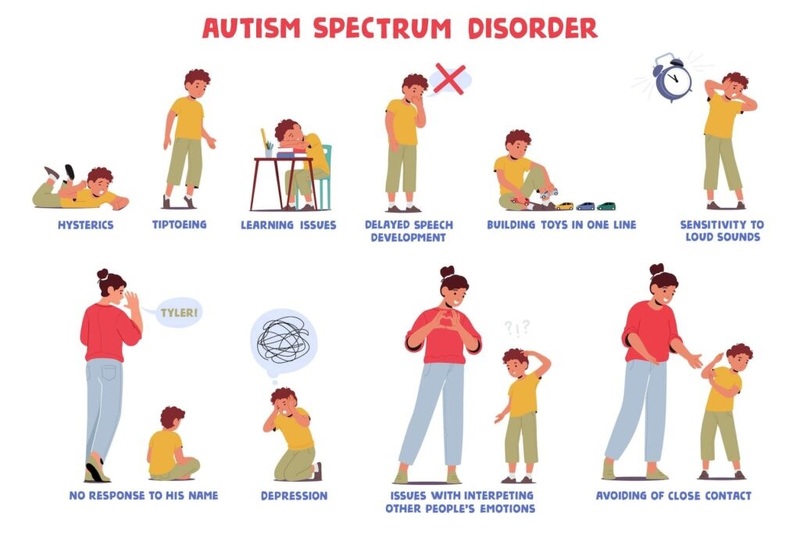
Notes: The symptoms listed above are only general signs and reference points. They help raise awareness, but they are not meant for self-diagnosis. Many of these traits can also appear in other developmental conditions or even in neurotypical individuals. If you notice persistent patterns either in someone else or in yourself, it’s best to consult a licensed professional for a proper assessment as early as possible.
Coming to the long-time fan-favorite animated series The Simpsons, there exists an ongoing discussion among the neurodivergent and pop culture community about one particular character: Bart Simpson, the 10-year-old eldest son of Homer and Marge Simpson. And the topic is: Is Bart Simpson autistic? The short answer is no.
At the very least, Bart, voiced by Nancy Cartwright, has never been officially confirmed as autistic in canon. There is no episode, no creator statement, and no canonical material that explicitly identifies him as autistic. Neither Matt Groening, Al Jean, nor any credited writer has ever stated that the character was written to represent someone on the autism spectrum.

It’s easy to see as to why many people think so, though. As the eldest of the three children, Bart Simpson often shows behaviors that fans frequently cue when discussing the possibility of autism:
Struggles to focus in class and is often disruptive. Episodes like Bart Gets an F and Brother’s Little Helper highlight this. Specifically, in Bart Gets an F, Bart repeatedly fails exams despite trying to study, and in Brother’s Little Helper, he is diagnosed with ADHD and put on the drug Focusyn for his hyperactive classroom behavior.
Poor control over his behavior, frequently acting out without restraint. You can see this in Brother’s Little Helper. In that episode, his impulsivity escalates so much that he hijacks a tank and causes chaos in Springfield.
Sometimes reacts unusually or rebellious toward authority figures like Principal Skinner and teachers. Sweet Seymour Skinner’s Baadasssss Song is an episode that illustrates this. In it, Bart’s prank with his dog leASD to Skinner being fired.
Shows impulsive behaviors, such as prank calls, reckless skateboarding, or stealing. These are recurring gags across The Simpsons, especially his classic prank calls to Moe’s Tavern and dangerous stunts on his skateboard.
Now, let’s compare and contrast with the core domain criteria of autism. Communication and interaction-wise, Bart shows conflict with authority but still maintains friendships (notably with Milhouse) and social awareness. In terms of repetitive behavior present, it is occasionally there but not strongly. We cannot draw a consistent pattern of ritualistic or fixated interests.
Sensory sensitivity presence is also rarely depicted. The boy generally handles environments without showing the strong hypersensitivity or hyposensitivity. Is early developmental onset evident in Bart Simpson? Canon does not portray delays in early childhood speech or nonverbal communication. Instead, Bart’s difficulties emerge in school settings.
At the same time, traits of hyperactivity and inattention do present, such as his restlessness in class, distractibility, and impulsive pranks. But combined with his intact social reciprocity, age-appropriate language skills, and the absence of consistent repetitive or sensory symptoms, alongside no official statement and no canonical confirmation, it’s safe to say that Bart Simpson is not autistic.
On another note, most experts and fan communities tend to interpret Bart’s behavior as more of an ADHD profile (a kind of neurodevelopmental disorder characterized by inattention, hyperactivity, and impulsivity) rather than autism. It is also clearly depicted in the show. In the episode Brother’s Little Helper (Season 11), he is explicitly diagnosed with ADHD and prescribed the drug Focusyn.

Even though ADHD and autism can co-occur in the same individual, the presence of ADHD traits does not automatically imply autism, and not the other way around. We will discuss more about this in the next section.
In the clinical setting, autism and ADHD often associate with one another. Research indicates that around 50-70% of individuals with autism also meet criteria for ADHD. Meanwhile, 20-40% of those diagnosed with ADHD also show autistic traits.
That said, the two remain distinct diagnoses with different core domains. Generally speaking, autism has more identifiable symptoms involving social communication difficulties, repetitive behaviors, and sensory responses. Such features of ASD as intense fixations, echolalia, or unusual sensitivity to sound and texture do not typically appear in ADHD.
The table below highlights the differences between autism and ADHD:
|
Aspect |
Autism Spectrum Disorder (ASD) |
Attention-Deficit/Hyperactivity Disorder (ADHD) |
|
Core traits |
Social communication difficulties, restricted and repetitive behaviors |
Inattention, hyperactivity, impulsivity |
|
Onset |
Symptoms present from early developmental period (DSM-5, ICD-11) |
Usually recognized in early childhood, often in school settings |
|
Social interaction |
Trouble understanding social cues, may struggle with relationships |
Often social but may interrupt, act impulsively, or struggle to pay attention |
|
Behavior patterns |
Preference for routines, repetitive actions, intense interests |
Restlessness, distractibility, forgetfulness |
|
Sensory issues |
Common, including sensitivity to sound, light, textures |
Less common, though may occur in some individuals |
|
Overlap |
ASD and ADHD can co-occur (DSM-5 allows dual diagnosis) |
ADHD can co-occur with ASD |
Is there anyone else in The Simpsons on the spectrum? The show is known for exaggerating the personalities of its characters. Because of that, behavioral cues, especially those that resemble neurodivergent traits, are often easy to pick up.
Coming to ASD, autism as a clinical diagnosis was officially included in the DSM in 1980. The Simpsons premiered in 1989. Throughout its run, there has not been any episode where the words “autism” or “autistic” are used to describe a main character in a direct or confirmed way.
Still, it is not difficult to identify what fans often call “autistic coded traits.” These are behaviors that align with characteristics of autism without being labeled as such. In simple terms, some characters may behave in ways that resemble traits seen in autistic individuals, but the show does not declare them as autistic. This clearly does not apply to Bart.

If we consider who might come closest, many fans have pointed to Lisa Simpson. Some things you may miss out on is how often she feels alienated or socially isolated.One clear moment is when she says, "Being a brain has alienated me from all my friends", in the episode HOMR. In addition, her high intelligence, emotional intensity, social discomfort, literal thinking, and strong sense of justice are some traits that overlap with an autism profile.

Maggie Simpson is also a notable case. Bart’s little sister remains nonverbal despite being over one year old. Additionally, she displays unusually high intelligence. In Smart & Smarter (Season 15 Episode 13), Maggie is revealed to have an IQ of 167 after a preschool screening test. Such traits can resemble early signs of ASD.
Anyways, it is worth keeping in mind that none of these characters are confirmed to be autistic. Giving a character an autism label without clear canonical evidence can be misleading and may unintentionally reinforce stereotypes or misrepresent what autism actually looks like.
So, is Bart Simpson autistic? To sum it up, Bart Simpson is not autistic, canonically. There is no official confirmation from the show or its creators. Instead, he is explicitly diagnosed with ADHD in the series. It is also important not to label characters without direct confirmation. Representation matters, but we must distinguish between shared traits and a confirmed diagnosis.
Big fan of the series? Check out our officially licensed The Simpsons Merchandise collection and express your love!
Read more
0 comment