
By [email protected] in Sep 10, 2025
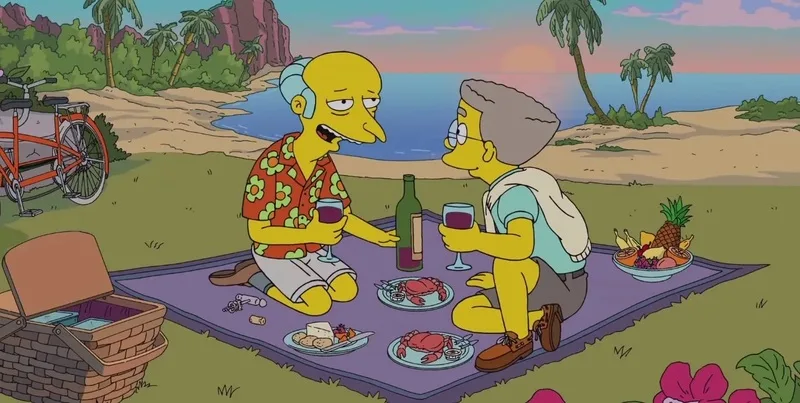
Are there any LGBT characters in The Simpsons? Known for its satire and social commentary, the show has gradually introduced queer storylines in a subtle yet impactful way. In this article, we’ll explore how LGBTQ+ representation has evolved in the show and highlight the most notable queer characters in its history.
LGBTQ+ has long struggled with accurate and meaningful representation in television. Before the 1990s, major US networks either avoided queer characters or depicted them as unstable, criminal, or comic relief. As late as 1994, there were only six recurring LGBTQ+ characters on all primetime television. In the meantime, positive portrayals of such characters were often blocked by internal censorship or fear of advertiser backlash.
So, how did LGBTQ+ representation take shape in The Simpsons? Running from December 17, 1989 to present, The Simpsons is one of the longest‑running and most influential animated sitcoms in television history with over 790 episodes across 36 seasons. And it was notably open to LGBTQ+ themes from very early on and has its portrayal through multiple episodes.
Right from the late 1990s, despite broader network hesitancy toward LGBTQ+ themes, The Simpsons introduced openly gay guest characters such as John in “Homer’s Phobia” (Season 8, 1997). Over its run, the audience gets to see recurring queer characters with clearer identities and more developed roles. Although early portrayals relied on subtext and satire, later seasons became more explicit and consistent in their representation.
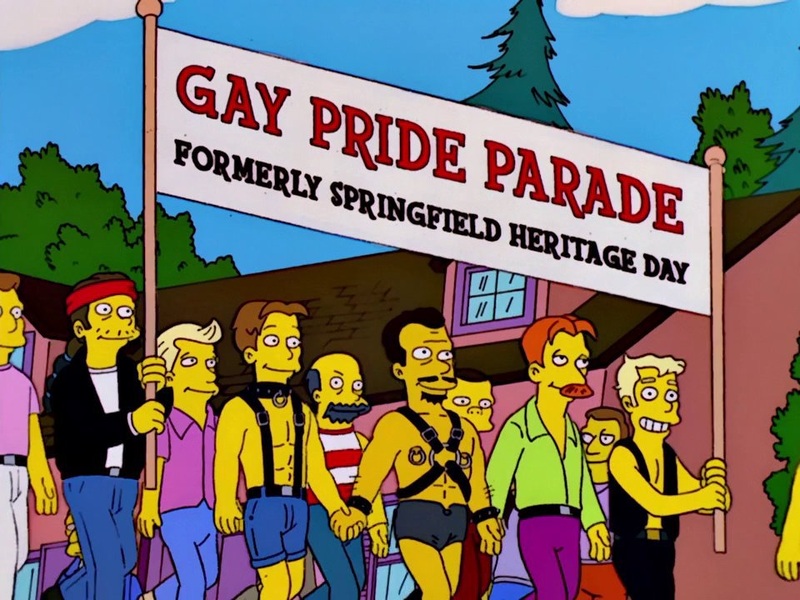
This approach was backed by producers. Matt Groening explained, “Springfield is meant to represent the whole world. Everybody has to be there.” Al Jean added that LGBTQ+ representation is important.
Below is a list of supporting characters in the series who are identified or implied as LGBT.
Patty is one of the twin sisters of Marge Simpson, the matriarch of the central family in the series. First appearing in 1989’s premiere season, she is known for her sharp, sarcastic personality. She is also often shown disapproving of Homer, her brother-in-law.
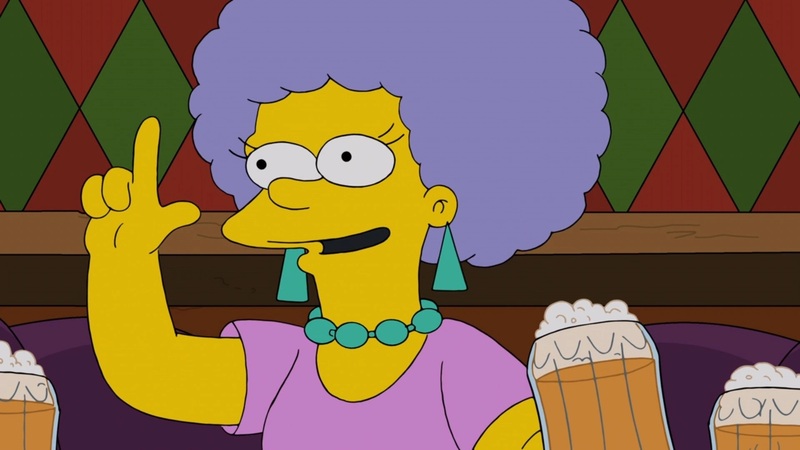
Patty Bouvier is the first recurring LGBT character in the Simpsons who officially came out as a lesbian in There’s Something About Marrying (Season 16, 2005). In that episode, she was engaged to Veronica, who was later revealed to be a man disguised as a woman. This twist led Patty to cancel the wedding and openly admit that she is attracted to women. During the same episode, she appeared on a pride parade float chanting “We’re gay! We’re glad! But don’t tell Mom and Dad!”
That said, there were early hints about Bouvier’s sexuality in the 1990s. In Principal Charming (Season 2, 1991), she dismissed romantic interest, and throughout later seasons she was portrayed as uninterested in men. Her sexuality was reaffirmed when she called off her wedding and dated Evelyn later on in Livin’ La Pura Vida (Season 31, Episode 7, 2019).
Fun fact: Patty’s coming-out episode aired in 2005, the same year that same-sex marriage was legalized in Canada (July 20, 2005) but still banned in most of the United States. This caused a lot of controversy at the time, especially from conservative groups.
The next LGBT character in The Simpsons is Waylon Smithers. Being the devoted personal assistant to Mr. Burns, who is a billionaire power-plant owner, he is portrayed as loyal, sycophantic, and often timid. He first appeared in Homer’s Odyssey (Season 1, Episode 3, 1990).
Smithers was long assumed to be gay because of recurring gags. Viewers can see him dream about Mr. Burns in Marge Gets a Job (Season 4, 1992). In addition to that is Lisa the Skeptic (Season 9, 1997), where he kisses Burns. However, for years the show kept it as regular jokes about Smithers’ sexuality, which led to debate among the fandom.
Waylon Smithers was finally confirmed as gay in The Burns Cage (Season 27, 2016) when the longtime closeted character confessed his love to Mr. Burns, only to be gently rejected. Homer then encouraged him to move on, and in Portrait of a Lackey on Fire (Season 33, 2021) he did, starting a relationship with Michael De Graaf.
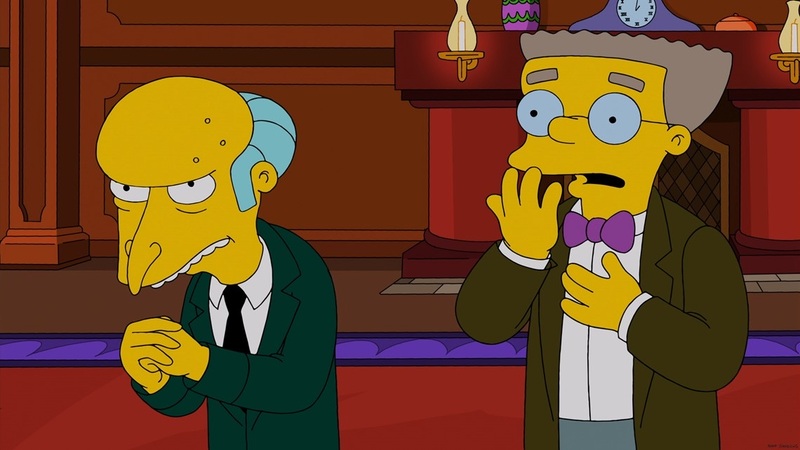
Waylon Smithers (right)
Kang and Kodos are recurring alien characters in The Simpsons, best known for appearing in nearly every “Treehouse of Horror” Halloween special since Season 2 (1990). They interact with the main family mostly in parody stories, often trying to invade Earth or mock humanity.
When it comes to the topic of LGBTQ+ representation in the series, the case of Kang and Kodos is kind of unusual. Their gender and sexuality have shifted over time. Early on, they were referred to as siblings, and Kodos was identified as Kang’s “sister” (Treehouse of Horror VII, Season 8, 1996). Later jokes presented them ambiguously, sometimes male, sometimes female, and sometimes both. At one point they were even described as “bros.”
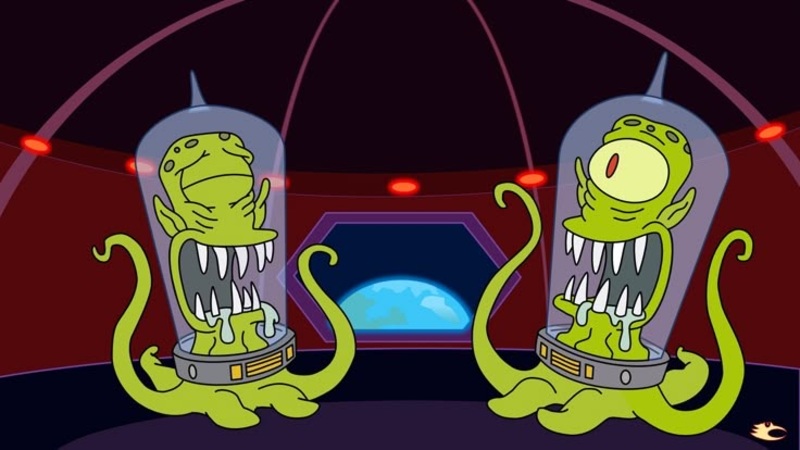
As per later commentary, producer Al Jean confirmed that they should be understood as a lesbian couple in their own species. Simpsorama (Season 26, 2014) leaned into this by implying they were partners.
Julio is quite popular within Springfield’s LGBT community. He debuted in Three Gays of the Condo (Season 14, Episode 11, aired 2003) as a gay Central American hairdresser, photographer, mixologist, and masseuse. Julio is also an old friend of Marge. In the episode, he was in a romantic living arrangement with Grady and hosted Homer, who had temporarily moved in after separating from Marge.
Fast forward a few years, we see him briefly married to Thad in Mad About the Toy (Season 30, Episode 11, 2019). Eventually, he shared a romantic arc with Waylon Smithers when they dated after The Burns Cage storyline (Portrait of a Lackey on Fire, Season 33, Episode 8, 2021).
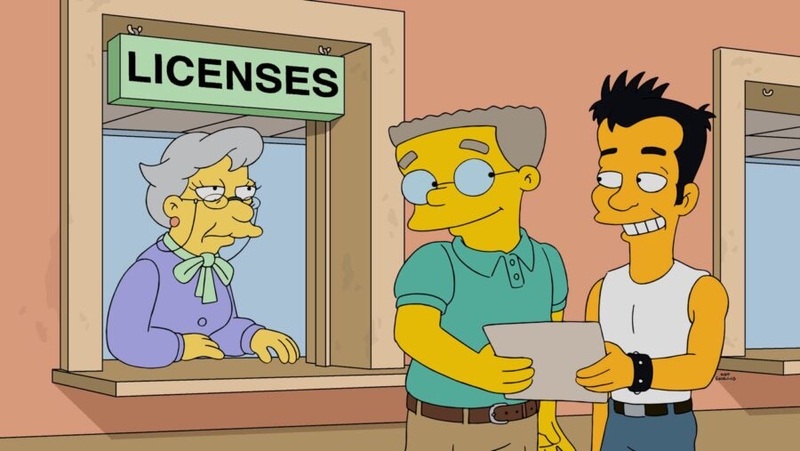
Julio (left) and Waylon Smithers (right)
Fun fact: Julio was originally voiced by Hank Azaria. However, the role was recast in 2021 and given to Tony Rodriguez, an openly gay Cuban American actor, after calls for more authentic LGBT and Latino representation.
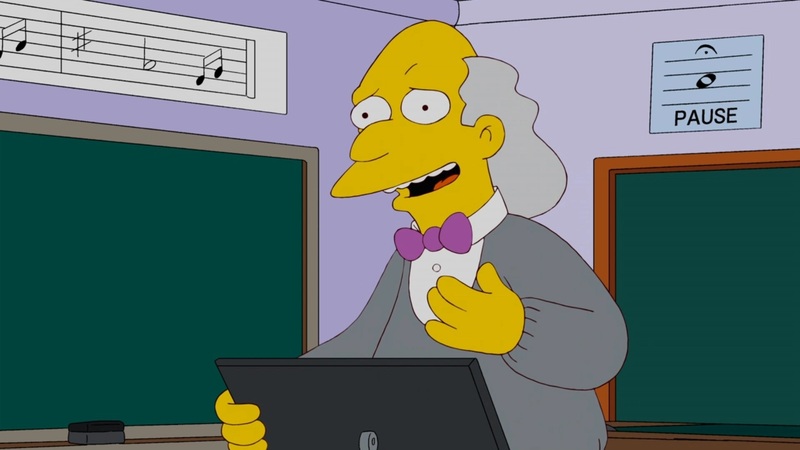
Are there any LGBT characters in The Simpsons? Yes, Dewey Largo is one of them. He is Lisa Simpson’s music teacher at Springfield Elementary who often displays uptight and humorless tendencies. You can spot him as early as Homer’s Odyssey (Season 1, Episode 3, 1990).
Dewey’s sexuality was not openly addressed at first but gradually acknowledged over the years, though. There was a scene in Flaming Moe (Season 22, Episode 11, 2011) where he ran off with his boyfriend after Moe’s bar was turned into a gay venue. Another hint came earlier when he was seen with Smithers after a car accident and insisted they were “just carpooling.” He is now openly gay in canon and later shown living with his partner, Geoffrey.
When talking about LGBT representation in The Simpsons, it is not just the main supporting cast who matter. Some recurring minor characters in the series have also been portrayed as LGBT. Grady, who debuted in Three Gays of the Condo (Season 14, 2003), was shown living with Julio. Karl, Homer’s assistant in Simpson and Delilah (Season 2, 1990), is often read as gay-coded. He, in fact, kissed Homer on the lips in that episode.
Let’s not forget about John, the openly gay collector voiced by John Waters in Homer’s Phobia (Season 8, 1997). If you have watched that episode, you know the entire story revolves around Homer confronting his own homophobia. Some other background characters shown at pride parades are explicitly gay, while a few Springfield residents have been hinted to be gay in gags, such as Lenny and Carl’s ambiguous relationship.
The lesbian characters in The Simpsons are also more diverse than just Patty Bouvier. They include Evelyn, who dated Patty in Livin’ La Pura Vida (Season 31, 2019), and Clarissa Wellington, who appears in later seasons as a lesbian newscaster. There are also characters hinted to be gay, such as Edna Krabappel in a few gags and Lindsey Naegle in background scenes.
Other representations include characters like Thad (Julio’s ex-husband), and Michael De Graaf (Smithers’ boyfriend in Portrait of a Lackey on Fire, Season 33, 2021). We can also add Roscoe, the flamboyantly gay steel mill foreman in Homer’s Phobia (Season 8, 1997), as well as various background couples and parade participants.
Here comes a list of all episodes covering LGBTQ+ characters:
|
# |
Episode Title |
Season / Episode |
Air Date |
Key LGBTQ+ Characters |
|
1 |
Simpson and Delilah |
S2, Ep 2 |
Oct 18, 1990 |
Karl |
|
2 |
Homer’s Phobia |
S8, Ep 15 |
Feb 16, 1997 |
John, Roscoe |
|
3 |
Three Gays of the Condo |
S14, Ep 17 |
Apr 13, 2003 |
Julio, Grady |
|
4 |
There’s Something About Marrying |
S16, Ep 10 |
Feb 20, 2005 |
Patty Bouvier |
|
5 |
Flaming Moe |
S22, Ep 11 |
Jan 16, 2011 |
Dewey Largo |
|
6 |
The Burns Cage |
S27, Ep 17 |
Apr 3, 2016 |
Waylon Smithers |
|
7 |
Mad About the Toy |
S30, Ep 11 |
Jan 6, 2019 |
Julio, Thad |
|
8 |
Livin’ La Pura Vida |
S31, Ep 7 |
Nov 17, 2019 |
Patty, Evelyn |
|
9 |
Portrait of a Lackey on Fire |
S33, Ep 8 |
Nov 21, 2021 |
Waylon Smithers, Michael De Graaf |
So there you have it, the answer to “Are there any LGBT characters in The Simpsons?” In fact, there are quite a lot of LGBT representations in the show, ranging from one-off icons like John and Roscoe to long-running characters like Patty and Smithers. Despite being played for satire in earlier years, the show has gradually moved toward more open and consistent portrayals, reflecting changing attitudes toward how television addresses queer identities.
Big fan of the series? Check out our officially licensed The Simpsons Merchandise collection and express your love!
0 comment