
By [email protected] in Sep 24, 2025
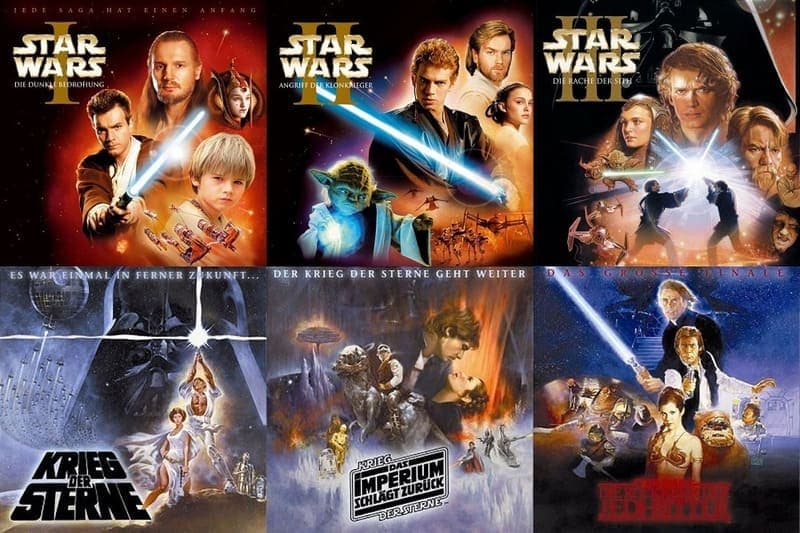
Star Wars is one of the most iconic science-fiction series in film history. With its complex storytelling, the saga has captivated millions of viewers around the world. Yet it is not only famous for epic lightsaber battles and legendary characters, but also for its unusual episode numbering that has left many fans scratching their heads. Why is Star Wars Episode 4 5 6 then 1 2 3? This article will explain why the series was released in such a special way and suggest popular viewing orders for the most complete experience.
This goes back to the late 1970s. In 1977, Star Wars Episode IV was released for the first time, with the official title being simply Star Wars, no “Episode IV” or "A New Hope" attached. In other words, the original movie did not begin with IV. It was not until the re-release of Star Wars in 1981 did audiences spot the change. The film then got the full title Episode IV A New Hope.
The idea behind the number was to signal that the movie was part of a larger ongoing saga. The creator of Star Wars, George Lucas, originally intended to make just one movie. But after it became a massive box office success, he decided to continue the story with sequels, which was first clearly hinted in 1980 with the inclusion of Episode V in the opening crawl of the sequel The Empire Strikes Back. That is how the numbering system came to be.
Lucas always imagined a trilogy of trilogies, with the total being 9 films. And trilogy 4, 5, 6 came first simply because the original movie was written as the middle part of a bigger story. For such a reason, he couldn’t name it I or II. However, he had outlined background events before Episode IV.
But why 4 first? Or in other words, why did the creator choose the middle part of the storyline for the original run? Normally, audiences expect a movie series to begin at Episode I. George Lucas chose to release Star Wars starting from Episode IV, though. Here are the reasons:
Production reality: Lucas only had funding and studio backing to make one film. He chose the part of the story that worked best as a standalone feature.
Story design: The original script was based on the middle section of a broader story outline. Lucas had sketched the larger universe but developed Episode IV first.
Structural clarity: Episode IV featured a complete arc with a clear beginning, middle, and end. It introduced key characters without requiring political backstory.
Limited resources: Lucas confirmed that the technology and visual effects needed for prequel content were not yet available in the late 1970s.
In addition, some believe that starting in the middle allowed Lucas to create a sense of myth and history from the very first film. By skipping past the origin story and placing audiences in an active galactic conflict, Episode IV felt like part of a much older universe. This gave the story immediate weight and mystery.
One thing that also confuses people is why after Episodes IV to VI they did not just go immediately into VII to IX and then return to I to III to keep it linear. After finishing the original trilogy (Episodes IV to VI), many assumed the franchise would continue the timeline forward. However, George Lucas went back and made the prequel trilogy (I to III) between 1999 and 2005. By contrast, the sequel trilogy (VII to IX) came much later, under Disney in 2015 to 2019.
Such order of release may come down to:
Prequel groundwork: Lucas had already developed detailed notes about the fall of the Republic, the Clone Wars, and Anakin's transformation into Darth Vader as early as the 1970s. It was just that the technology back then did not allow him to realize his full vision for that era. Furthermore, he was more interested in exploring Darth Vader’s origins.
The sequel trilogy delay: In fact, Lucas did not plan for sequels immediately after the prequels. He did publicly state he had no plans to continue beyond Episode VI. Episode VII‑IX only happened when Lucasfilm was sold to Disney in 2012 and new filmmakers took over.
Nevertheless, all the numbered films of the Skywalker saga were a big commercial success and became cultural landmarks in cinema history. All entries were high-grossing, with many surpassing hundreds of millions worldwide, and several topping the one billion mark. Despite the final trilogy being produced under Disney rather than George Lucas, it still achieved massive global box office returns.
Below is a timeline summarizing the release order and numbering of the main Star Wars films:
|
Trilogy |
Episodes |
Release Years |
|
Original Trilogy |
Episode IV – A New Hope |
1977 |
|
Episode V – The Empire Strikes Back |
1980 | |
|
Episode VI – Return of the Jedi |
1983 | |
|
Prequel Trilogy |
Episode I – The Phantom Menace |
1999 |
|
Episode II – Attack of the Clones |
2002 | |
|
Episode III – Revenge of the Sith |
2005 | |
|
Sequel Trilogy |
Episode VII – The Force Awakens |
2015 |
|
Episode VIII – The Last Jedi |
2017 | |
|
Episode IX – The Rise of Skywalker |
2019 |
New to the galaxy far, far away? We hope that you have now understood why is Star Wars Episode 4 5 6 then 1 2 3. Regarding the viewing experience, there are several ways to watch the saga depending on your preference.
Basically, you watch the saga in the order the films came out. Start with Episode IV, V, VI. Then look at Episode I, II, III in sequence and end with Episode VII, VIII, IX.
This order matches the real-life experience of audiences from 1977 onward. You get the major plot twist in The Empire Strikes Back (Episode V) revealed as intended. It also allows you to see how storytelling and visual effects evolved over the decades.
It can be a bit confusing for newcomers, though. As you move from Episode VI to Episode I, you can find the timeline jumps back and forth. In addition, watching the prequels after already knowing key revelations can reduce the emotional impact.
Yet, this is the most commonly recommended order for first-time viewers. This order does a great job at preserving major plot twists and aligning with the historical journey of Star Wars as a franchise.
Another way to watch Star Wars is to view the films in chronological order. That means starting with the prequels, followed by the original trilogy, and ending with the sequels. The full order is Star Wars 1-2-3-4-5-6-7-8-9.
This order lets you follow the rise, fall, and redemption of Anakin Skywalker and then continue directly into the legacy of his children and grandchildren. No timeline jumps, no flashbacks, just one continuous narrative.
However, watching in this order reveals major twists (like Darth Vader’s true identity) far too early. It can ruin the joy of experiencing the surprise and emotional impact of Episodes V and VI.

So, who should watch this way? It would work well for those who prefer a linear story. If you don’t mind spoilers and just want to follow the narrative from beginning to end, go ahead. It’ll be a smooth and coherent watch. This is also the preferred order for many returning viewers or those who already know the big plot points by heart.
With this Star Wars viewing order, you begin with the first two major episodes of the main plots, then jump right to the heart of the prequel to get more insights into Anakin’s fall and the rise of the Empire. Finally, you return to Episode VI for the conclusion. The order goes like this: Star War 4-5-2-3-6.
The Machete order is a fan-created viewing order that has gained popularity over the years. It’s not official, but many longtime fans recommend it because it retains the surprise reveal of Darth Vader being Luke’s father and keeps the tension consistent. In the meanwhile, emotional depth was added by showing Anakin’s backstory.
The sacrifice is the Episode I and the sequel trilogy (VII to IX). That means you will miss out on some worldbuilding and character introductions, especially Qui-Gon’s role and the official beginning of the saga. Alongside is the loss of closure on characters like Leia and Luke, plus major developments with Kylo Ren and Rey. Yet, this omission shouldn’t disrupt the core arc of the original sage: Anakin’s fall and redemption.
We recommend this order for newcomers finding the full nine-film run too much to start with. It’s enough for you to understand the main Skywalker storyline. You can always come back to view the remaining episodes later for a fuller picture. Some fans also rewatch in this order because it trims unnecessary distractions and focuses on the emotional arc of the saga.
Still don’t know where to start? Here’s a quick guide that may help you decide:
Choose Original Release Order: You want to experience the story the same way audiences did from 1977 to 2019 and preserve iconic plot twists like “I am your father.”
Choose Chronological Order: You prefer a linear timeline and want to follow Anakin’s journey from childhood to Darth Vader without skipping around.
Choose Machete Order: You want a streamlined experience that focuses on the emotional arc of Anakin while preserving the big reveals and cutting filler content.
So there you have it, the answer to Why is Star Wars Episode 4 5 6 then 1 2 3? We also broke down the different watch orders to help you decide how to enjoy the galaxy-spanning saga in the best way possible.
Long story short, Episode IV was numbered “4” because it was originally meant to be the middle part of a much larger story. But Lucas only planned to make one movie at first, so he chose the part that was the most exciting and self-contained, even if it wasn’t the chronological beginning. Simple as that.
Huge fan of the Star Wars universe? Then you’ve come to the right place! Explore our Star Wars merchandise collection featuring a wide range of officially licensed apparel, mugs, and more. All items are crafted with high-quality prints and bold designs. Check it out now and bring the Force home.
ALSO READ:
0 comment